
Overview
The betaregscale package provides maximum-likelihood estimation of beta regression models for responses derived from bounded rating scales. Common examples include pain intensity scales (NRS-11, NRS-21, NRS-101), Likert-type scales, product quality ratings, and any instrument whose response can be mapped to the open interval .
The key idea is that a discrete score recorded on a bounded scale carries measurement uncertainty inherent to the instrument. For instance, a pain score of on a 0–10 NRS is not an exact value but rather represents a range: after rescaling to , the observation is treated as interval-censored in . The package uses the beta distribution to model such data, building a complete likelihood that supports mixed censoring types within the same dataset (Lopes, 2023).
Installation
# Development version from GitHub:
# install.packages("remotes")
remotes::install_github("evandeilton/betaregscale")The score scale and ncuts
ncuts is
,
the maximum score. Scores run over
,
so the scale has
categories: an NRS-11 pain scale (0 to 10) has ncuts = 10,
a 0 to 100 scale ncuts = 100. The lowest score is the left
border and the highest the right border of the scale.
A scale that starts at 1 must be shifted to start at 0. A Likert item
1 to 5 becomes 0 to 4, with ncuts = 4:
| left | right | yt | y | delta |
|---|---|---|---|---|
| 0.000 | 0.125 | 0.00 | 0 | 1 |
| 0.125 | 0.375 | 0.25 | 1 | 3 |
| 0.375 | 0.625 | 0.50 | 2 | 3 |
| 0.875 | 1.000 | 1.00 | 4 | 2 |
| 0.625 | 0.875 | 0.75 | 3 | 3 |
| 0.000 | 0.125 | 0.00 | 0 | 1 |
Without the shift, category 1 would be read as an interior score and the lower border of the scale would be a category that nobody can choose:
brs_check(likert, ncuts = 5)[, "delta"]
#> [1] 3 3 3 2 3 3
Likelihood and censoring types
The complete likelihood supports four censoring types, automatically
classified by brs_check():
| Type | Likelihood contribution | |
|---|---|---|
| 0 | Exact (uncensored) | |
| 1 | Left-censored () | |
| 2 | Right-censored () | |
| 3 | Interval-censored |
where and are the beta density and CDF, are the interval endpoints, and are the beta shape parameters derived from and via the chosen reparameterization. The likelihood is the product
This is the complete likelihood of Lopes (2023). The table of censoring types in the dissertation swaps the labels and ; the package follows its equation. The cells are fixed by the scale, not by the observed value, so the censoring is non-informative.
Interval construction
A score
is mapped to a cell of
.
The direction of the uncertainty interval is set by
interval (the cases
,
and
of Lopes, 2023):
interval |
cell of score | latent score of |
|---|---|---|
"mid" (default) |
||
"right" |
||
"left" |
is the maximum score (ncuts) and
the half-width (lim, default 0.5, used by
"mid" only). The
cells of "right" and "left" are equal and
partition
;
this normalisation is a package choice (the dissertation divides by
).
"right" and "left" give the same fit and
differ only in predict(type = "score"). The three
directions are different coarsening models, so anova()
refuses to compare them.
The borders need no special transformation: score 0 is left-censored and score right-censored, and endpoints are only clamped to as a numerical guard. The fit therefore does not depend on the sample size, unlike the transformation of Smithson and Verkuilen (2006).
# Illustrate brs_check with a 0-10 NRS scale
y_example <- c(0, 3, 5, 7, 10)
cr <- brs_check(y_example, ncuts = 10)
kbl10(cr)| left | right | yt | y | delta |
|---|---|---|---|---|
| 0.00 | 0.05 | 0.0 | 0 | 1 |
| 0.25 | 0.35 | 0.3 | 3 | 3 |
| 0.45 | 0.55 | 0.5 | 5 | 3 |
| 0.65 | 0.75 | 0.7 | 7 | 3 |
| 0.95 | 1.00 | 1.0 | 10 | 2 |
The delta column shows that
is left-censored
(),
is right-censored
(),
and all interior values are interval-censored
().
The same scores with right-direction cells:
kbl10(brs_check(y_example, ncuts = 10, interval = "right"))| left | right | yt | y | delta |
|---|---|---|---|---|
| 0.0000 | 0.0909 | 0.0455 | 0 | 1 |
| 0.2727 | 0.3636 | 0.3182 | 3 | 3 |
| 0.4545 | 0.5455 | 0.5000 | 5 | 3 |
| 0.6364 | 0.7273 | 0.6818 | 7 | 3 |
| 0.9091 | 1.0000 | 0.9545 | 10 | 2 |
Values already in are exact observations (), one observation at a time. Input that mixes such values with scores is ambiguous and gives a warning:
kbl10(brs_check(c(0.3, 5, 10), ncuts = 10))
#> Warning: The response mixes values in (0, 1) with values >= 1: values in (0, 1)
#> are taken as exact (delta = 0), the others as scores on 0..ncuts. Rescale the
#> data if the (0, 1) values are scores (half-point scores: use y * 2 and ncuts *
#> 2).| left | right | yt | y | delta |
|---|---|---|---|---|
| 0.30 | 0.30 | 0.3 | 0.3 | 0 |
| 0.45 | 0.55 | 0.5 | 5.0 | 3 |
| 0.95 | 1.00 | 1.0 | 10.0 | 2 |
Data preparation with brs_prep()
In practice, analysts may want to supply their own censoring
indicators or interval endpoints rather than relying on the automatic
classification of brs_check(). The brs_prep()
function provides a flexible, validated bridge between raw analyst data
and brs().
It supports four input modes:
Mode 1: Score only (automatic)
# Equivalent to brs_check - delta inferred from y
d1 <- data.frame(y = c(0, 3, 5, 7, 10), x1 = rnorm(5))
kbl10(brs_prep(d1, ncuts = 10))| left | right | yt | y | delta | x1 |
|---|---|---|---|---|---|
| 0.00 | 0.05 | 0.0 | 0 | 1 | -1.4000 |
| 0.25 | 0.35 | 0.3 | 3 | 3 | 0.2553 |
| 0.45 | 0.55 | 0.5 | 5 | 3 | -2.4373 |
| 0.65 | 0.75 | 0.7 | 7 | 3 | -0.0056 |
| 0.95 | 1.00 | 1.0 | 10 | 2 | 0.6216 |
Mode 2: Score + explicit censoring indicator
# Analyst specifies delta directly
d2 <- data.frame(
  y     = c(50, 0, 99, 50),
  delta = c(0, 1, 2, 3),
  x1    = rnorm(4)
)
kbl10(brs_prep(d2, ncuts = 100))| left | right | yt | y | delta | x1 |
|---|---|---|---|---|---|
| 0.500 | 0.500 | 0.50 | 50 | 0 | 1.1484 |
| 0.000 | 0.005 | 0.00 | 0 | 1 | -1.8218 |
| 0.985 | 1.000 | 0.99 | 99 | 2 | -0.2473 |
| 0.495 | 0.505 | 0.50 | 50 | 3 | -0.2442 |
Mode 3: Interval endpoints with NA patterns
When the analyst provides left and/or right
columns, censoring is inferred from the NA pattern. Bounds are on the
latent score scale and must lie in
under "mid"
(
and
under "right" and "left"). An interval that
reaches 0 or 1 on the unit scale becomes left- or right-censored; one
that reaches both covers the whole scale, carries no information and
gives a warning.
d3 <- data.frame(
  left  = c(NA, 20, 30, NA),
  right = c(5, NA, 45, NA),
  y     = c(NA, NA, NA, 50),
  x1    = rnorm(4)
)
kbl10(brs_prep(d3, ncuts = 100))| left | right | yt | y | delta | x1 |
|---|---|---|---|---|---|
| 0.0 | 0.05 | 0.025 | 2.5 | 1 | -0.2827 |
| 0.2 | 1.00 | 0.600 | 60.0 | 2 | -0.5537 |
| 0.3 | 0.45 | 0.375 | 37.5 | 3 | 0.6290 |
| 0.5 | 0.50 | 0.500 | 50.0 | 0 | 2.0650 |
Mode 4: Analyst-supplied intervals
When the analyst provides y, left, and
right simultaneously, their endpoints are used directly
(rescaled by
under "mid"):
d4 <- data.frame(
  y     = c(50, 75),
  left  = c(48, 73),
  right = c(52, 77),
  x1    = rnorm(2)
)
kbl10(brs_prep(d4, ncuts = 100))| left | right | yt | y | delta | x1 |
|---|---|---|---|---|---|
| 0.48 | 0.52 | 0.50 | 50 | 3 | -1.6310 |
| 0.73 | 0.77 | 0.75 | 75 | 3 | 0.5124 |
Using brs_prep with brs()
Data processed by brs_prep() is automatically detected
by brs() - the internal brs_check() step is
skipped:
set.seed(42)
n <- 200
dat <- data.frame(x1 = rnorm(n), x2 = rnorm(n))
sim <- brs_sim(
  formula = ~ x1 + x2, data = dat,
  beta = c(0.2, -0.5, 0.3), phi = 0.3,
  link = "logit", link_phi = "logit",
  repar = 2
)
# Remove left, right, yt so brs_prep can rebuild them
prep <- brs_prep(sim[-c(1:3)], ncuts = 100)
fit_prep <- brs(y ~ x1 + x2,
  data = prep, repar = 2,
  link = "logit", link_phi = "logit"
)
summary(fit_prep, digits = 4)
#>
#> Call:
#> brs(formula = y ~ x1 + x2, data = prep, link = "logit", link_phi = "logit",
#>     repar = 2)
#>
#> Quantile residuals:
#>     Min      1Q  Median      3Q     Max
#> -3.3566 -0.7310 -0.0537  0.6635  2.9618
#>
#> Coefficients (mean model with logit link):
#>             Estimate Std. Error z value Pr(>|z|)
#> (Intercept)   0.1946     0.0996   1.954   0.0507 .
#> x1           -0.5456     0.1079  -5.057 4.26e-07 ***
#> x2            0.2204     0.1067   2.066   0.0389 *
#> ---
#> Signif. codes:  0 '***' 0.001 '**' 0.01 '*' 0.05 '.' 0.1 ' ' 1
#>
#> Phi coefficients (precision model with logit link):
#>       Estimate Std. Error z value Pr(>|z|)
#> (phi)   0.3326     0.0910   3.655 0.000257 ***
#> ---
#> Signif. codes:  0 '***' 0.001 '**' 0.01 '*' 0.05 '.' 0.1 ' ' 1
#> ---
#> Log-likelihood: -804.9904 on 4 Df | AIC: 1617.9809 | BIC: 1631.1741
#> Pseudo R-squared: 0.1372  (midpoint approx.; interpret with caution for heavily censored data)
#> Number of iterations: 28 (BFGS)
#> Censoring: 152 interval | 19 left | 29 right
Example 1: Fixed dispersion model
Simulating data
We simulate observations from a beta regression model with fixed dispersion, two covariates, and a logit link for the mean.
set.seed(4255)
n <- 250
dat <- data.frame(x1 = rnorm(n), x2 = rnorm(n))

sim_fixed <- brs_sim(
  formula  = ~ x1 + x2,
  data     = dat,
  beta     = c(0.3, -0.6, 0.4),
  phi      = 1 / 10,
  link     = "logit",
  link_phi = "logit",
  ncuts    = 100,
  repar    = 2
)

kbl10(head(sim_fixed, 8))| left | right | yt | y | delta | x1 | x2 |
|---|---|---|---|---|---|---|
| 0.805 | 0.815 | 0.81 | 81 | 3 | 1.9510 | -1.3482 |
| 0.585 | 0.595 | 0.59 | 59 | 3 | 0.7725 | 1.2966 |
| 0.245 | 0.255 | 0.25 | 25 | 3 | 0.7264 | 1.1585 |
| 0.965 | 0.975 | 0.97 | 97 | 3 | 0.0487 | 0.6334 |
| 0.285 | 0.295 | 0.29 | 29 | 3 | -0.5445 | 0.1161 |
| 0.795 | 0.805 | 0.80 | 80 | 3 | 0.3600 | -0.2545 |
| 0.355 | 0.365 | 0.36 | 36 | 3 | 0.7136 | 0.7694 |
| 0.745 | 0.755 | 0.75 | 75 | 3 | -0.7274 | 1.0397 |
Each observation is centered in its interval. For example, a score of 67 on a 0–100 scale yields with the interval .
Fitting the model
fit_fixed <- brs(
  y ~ x1 + x2,
  data     = sim_fixed,
  link     = "logit",
  link_phi = "logit",
  repar    = 2
)
summary(fit_fixed)
#>
#> Call:
#> brs(formula = y ~ x1 + x2, data = sim_fixed, link = "logit",
#>     link_phi = "logit", repar = 2)
#>
#> Quantile residuals:
#>     Min      1Q  Median      3Q     Max
#> -2.8953 -0.6209  0.0858  0.6729  3.4008
#>
#> Coefficients (mean model with logit link):
#>             Estimate Std. Error z value Pr(>|z|)
#> (Intercept)  0.35460    0.08730   4.062 4.87e-05 ***
#> x1          -0.65902    0.09482  -6.950 3.64e-12 ***
#> x2           0.32880    0.09221   3.566 0.000363 ***
#> ---
#> Signif. codes:  0 '***' 0.001 '**' 0.01 '*' 0.05 '.' 0.1 ' ' 1
#>
#> Phi coefficients (precision model with logit link):
#>       Estimate Std. Error z value Pr(>|z|)
#> (phi)  0.15143    0.08202   1.846   0.0649 .
#> ---
#> Signif. codes:  0 '***' 0.001 '**' 0.01 '*' 0.05 '.' 0.1 ' ' 1
#> ---
#> Log-likelihood: -989.6966 on 4 Df | AIC: 1987.3932 | BIC: 2001.4790
#> Pseudo R-squared: 0.2264  (midpoint approx.; interpret with caution for heavily censored data)
#> Number of iterations: 29 (BFGS)
#> Censoring: 198 interval | 14 left | 38 right
The summary output follows the betareg package style,
showing separate coefficient tables for the mean and precision
submodels, with Wald z-tests and
-values
based on the standard normal distribution.
Estimation and fit diagnostics
optim() (BFGS) maximises the log-likelihood, evaluated
in C++. The gradient and, by default, the Hessian use the chain rule on
the two linear predictors, with per-observation derivatives by
Richardson central differences (hessian_method = "cpp";
"numDeriv" is also available). Standard errors come from
the inverse of the negative Hessian; no generalised inverse is used.
brs() also accepts start and
control (merged into list(maxit = 5000)).
After the fit, brs() checks the result and stores the
numbers:
str(fit_fixed$diagnostics[c("grad_gain", "grad_step", "min_eig_scaled", "hessian_nd", "n_clamped")])
#> List of 5
#>  $ grad_gain     : num 3.06e-10
#>  $ grad_step     : num 2.15e-05
#>  $ min_eig_scaled: num 0.709
#>  $ hessian_nd    : logi TRUE
#>  $ n_clamped     : int 0
Each problem gives a one-line warning:
| Warning | Meaning | What to do |
|---|---|---|
| model matrix is rank deficient (error) | aliased columns | remove the named columns |
| model matrix is nearly collinear | condition number above | drop, combine or centre the named columns |
| Gradient not ~0 at the estimate | a Newton step would still gain more than 0.01 in log-likelihood | refit with method = "L-BFGS-B"; rescale
covariates whose scales differ widely (the message says so) |
| Hessian near-singular or not negative definite | a direction is nearly flat (not identified, or covariates on very different scales) |
vcov() gives NA where it
cannot estimate; rescale, use LR tests or the bootstrap, simplify |
| observations on the clamp boundary | means or shapes at or , e.g. a group entirely at one border | merge sparse groups or drop the separating covariate |
The classic case of the last two is a data set where every observation is censored on the same side: the likelihood has no finite maximum.
Goodness of fit
kbl10(brs_gof(fit_fixed))| logLik | AIC | BIC | pseudo_r2 |
|---|---|---|---|
| -989.6966 | 1987.393 | 2001.479 | 0.2264 |
Comparing link functions
The package supports several link functions for the mean submodel. We can compare them using information criteria:
links <- c("logit", "probit", "cauchit", "cloglog")
fits <- lapply(setNames(links, links), function(lnk) {
  brs(y ~ x1 + x2, data = sim_fixed, link = lnk, repar = 2)
})

# Estimates
est_table <- do.call(rbind, lapply(names(fits), function(lnk) {
  e <- brs_est(fits[[lnk]])
  e$link <- lnk
  e
}))
kbl10(est_table)| variable | estimate | se | z_value | p_value | ci_lower | ci_upper | link |
|---|---|---|---|---|---|---|---|
| (Intercept) | 0.3546 | 0.0873 | 4.0619 | 0.0000 | 0.1835 | 0.5257 | logit |
| x1 | -0.6590 | 0.0948 | -6.9505 | 0.0000 | -0.8449 | -0.4732 | logit |
| x2 | 0.3288 | 0.0922 | 3.5657 | 0.0004 | 0.1481 | 0.5095 | logit |
| (phi) | 0.1514 | 0.0820 | 1.8463 | 0.0649 | -0.0093 | 0.3122 | logit |
| (Intercept) | 0.2180 | 0.0532 | 4.0969 | 0.0000 | 0.1137 | 0.3223 | probit |
| x1 | -0.3964 | 0.0548 | -7.2312 | 0.0000 | -0.5038 | -0.2890 | probit |
| x2 | 0.1955 | 0.0547 | 3.5745 | 0.0004 | 0.0883 | 0.3026 | probit |
| (phi) | 0.1539 | 0.0819 | 1.8794 | 0.0602 | -0.0066 | 0.3144 | probit |
| (Intercept) | 0.3062 | 0.0824 | 3.7164 | 0.0002 | 0.1447 | 0.4677 | cauchit |
| x1 | -0.6286 | 0.1100 | -5.7153 | 0.0000 | -0.8441 | -0.4130 | cauchit |
| logLik | AIC | BIC | pseudo_r2 | |
|---|---|---|---|---|
| logit | -989.6966 | 1987.393 | 2001.479 | 0.2264 |
| probit | -989.8231 | 1987.646 | 2001.732 | 0.2229 |
| cauchit | -989.7611 | 1987.522 | 2001.608 | 0.1804 |
| cloglog | -989.7198 | 1987.439 | 2001.525 | 0.1437 |
Residual diagnostics
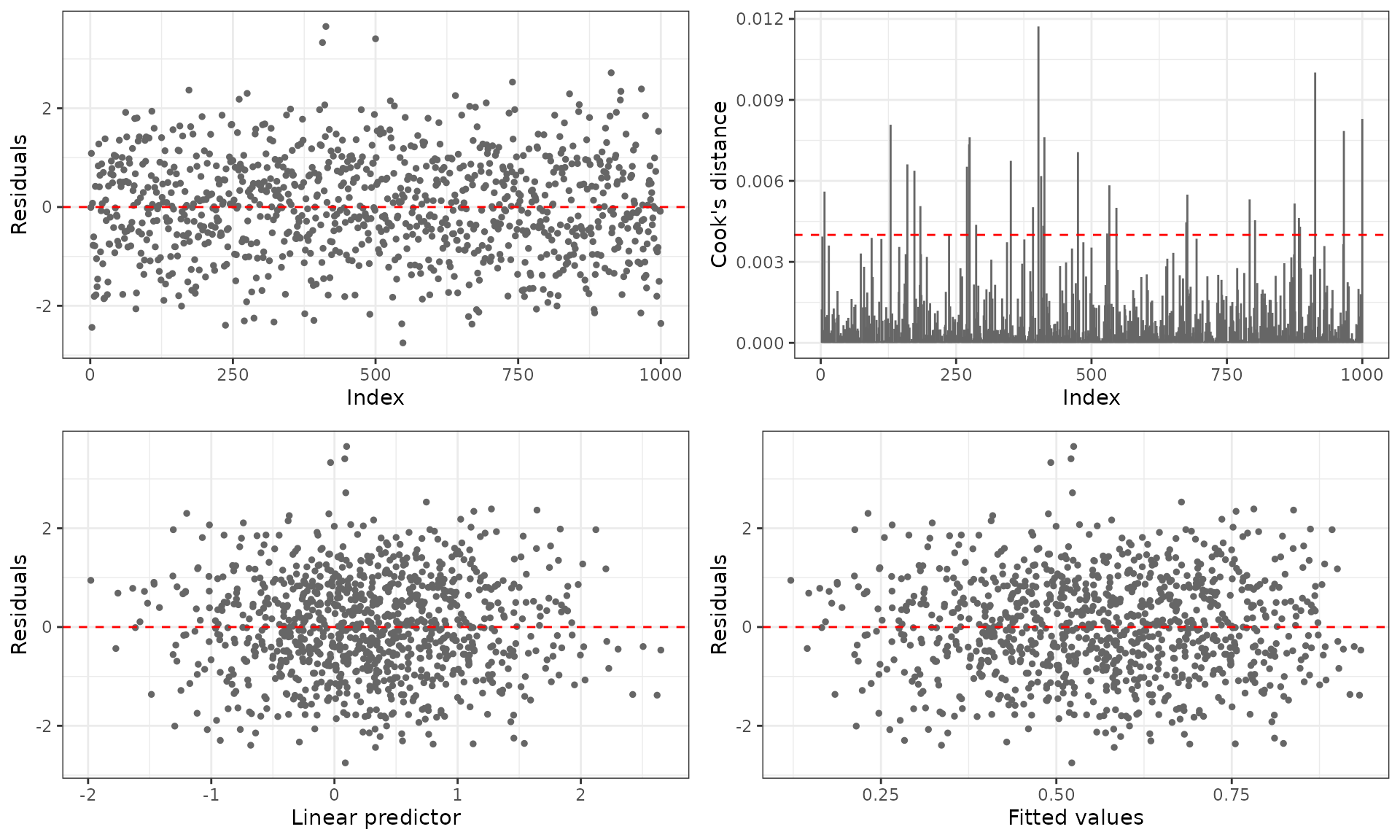
residuals() offers several types. Randomized quantile
residuals (type = "rqr", Dunn and Smyth, 1996) draw
uniformly on
(or
,
at the borders) and return
:
they are standard normal under the model whatever the censoring, and are
the recommended type. Pearson, deviance and weighted residuals are
evaluated at the cell centre (the midpoint convention of Lopes, 2023)
and are unreliable at the borders of the scale. summary()
draws the quantile residuals without changing the RNG state.
The plot() method provides six diagnostic panels. By
default, the first four are shown:
For ggplot2 output (requires the ggplot2 package):
plot(fit_fixed, gg = TRUE)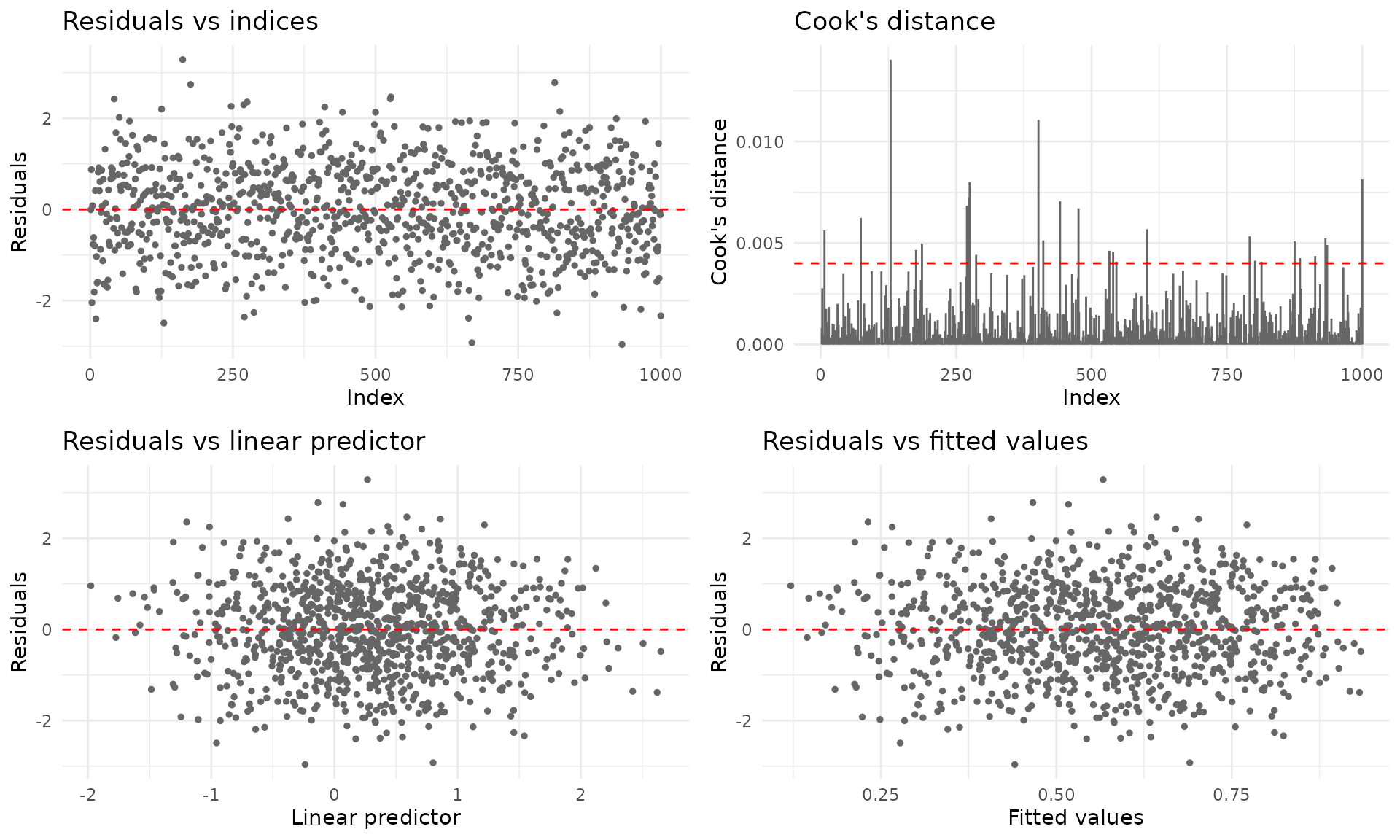
Predictions
# Fitted means
kbl10(
  data.frame(mu_hat = head(predict(fit_fixed, type = "response"))),
  digits = 4
)| mu_hat |
|---|
| 0.2019 |
| 0.5675 |
| 0.5638 |
| 0.6297 |
| 0.6795 |
| 0.5084 |
# Conditional variance
kbl10(
  data.frame(var_hat = head(predict(fit_fixed, type = "variance"))),
  digits = 4
)| var_hat |
|---|
| 0.0867 |
| 0.1320 |
| 0.1323 |
| 0.1254 |
| 0.1171 |
| 0.1344 |
# Quantile predictions
kbl10(predict(fit_fixed, type = "quantile", at = c(0.10, 0.25, 0.5, 0.75, 0.90)))| q_0.1 | q_0.25 | q_0.5 | q_0.75 | q_0.9 |
|---|---|---|---|---|
| 0.0000 | 0.0006 | 0.0329 | 0.3130 | 0.7400 |
| 0.0335 | 0.2024 | 0.6326 | 0.9348 | 0.9943 |
| 0.0322 | 0.1974 | 0.6255 | 0.9323 | 0.9940 |
| 0.0624 | 0.2999 | 0.7476 | 0.9688 | 0.9982 |
| 0.0979 | 0.3959 | 0.8302 | 0.9855 | 0.9995 |
| 0.0168 | 0.1306 | 0.5167 | 0.8863 | 0.9865 |
| 0.0231 | 0.1596 | 0.5678 | 0.9096 | 0.9905 |
| 0.1981 | 0.5958 | 0.9385 | 0.9980 | 1.0000 |
| 0.1001 | 0.4013 | 0.8341 | 0.9862 | 0.9995 |
| 0.0088 | 0.0860 | 0.4218 | 0.8340 | 0.9755 |
Confidence intervals
Wald confidence intervals based on the asymptotic normal approximation:
kbl10(confint(fit_fixed))| 2.5 % | 97.5 % | |
|---|---|---|
| (Intercept) | 0.1835 | 0.5257 |
| x1 | -0.8449 | -0.4732 |
| x2 | 0.1481 | 0.5095 |
| (phi) | -0.0093 | 0.3122 |
kbl10(confint(fit_fixed, model = "mean"))| 2.5 % | 97.5 % | |
|---|---|---|
| (Intercept) | 0.1835 | 0.5257 |
| x1 | -0.8449 | -0.4732 |
| x2 | 0.1481 | 0.5095 |
Censoring structure
The brs_cens() function provides a visual and tabular
overview of the censoring types in the fitted model:
brs_cens(fit_fixed, gg = TRUE, inform = TRUE)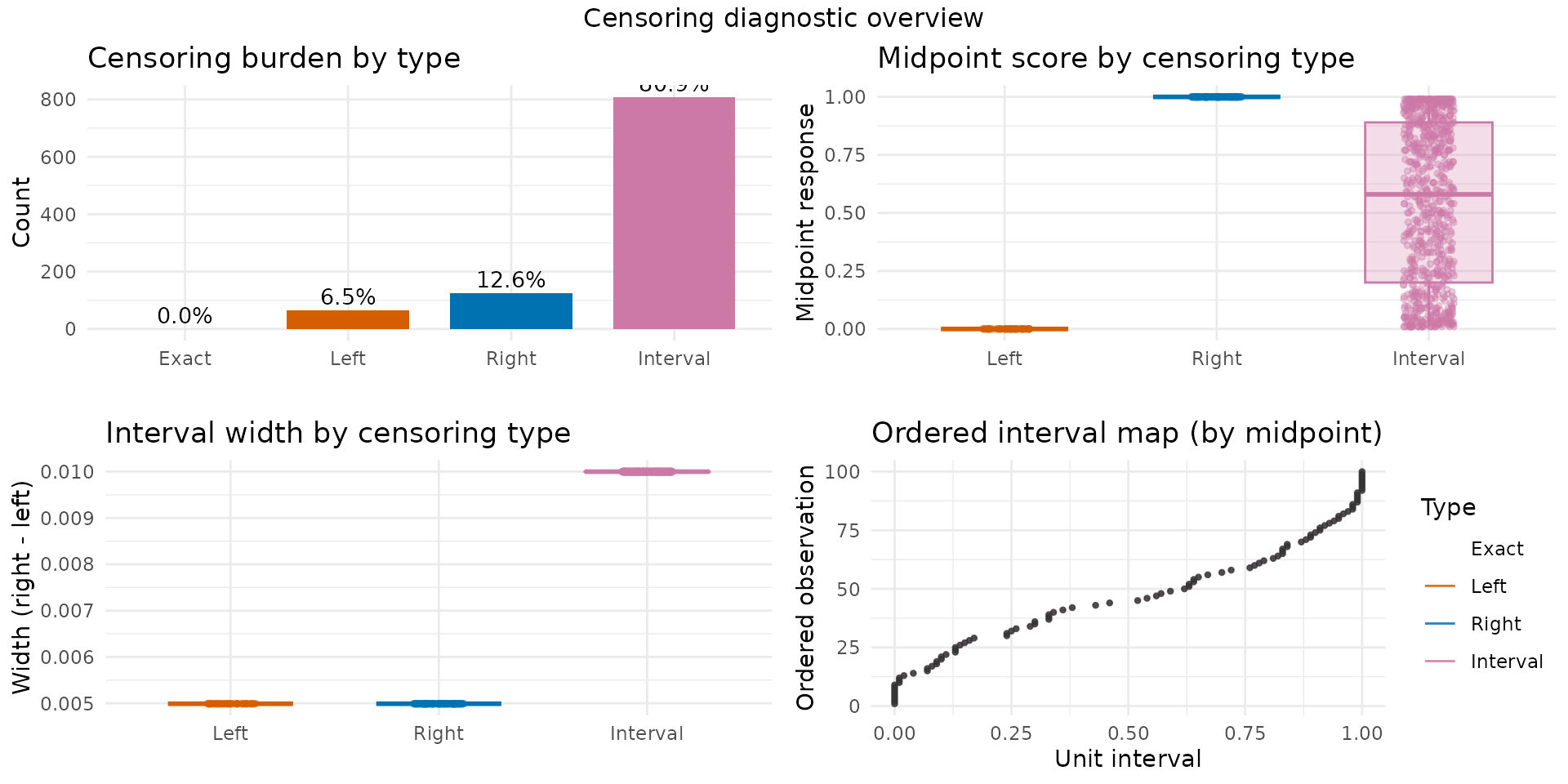
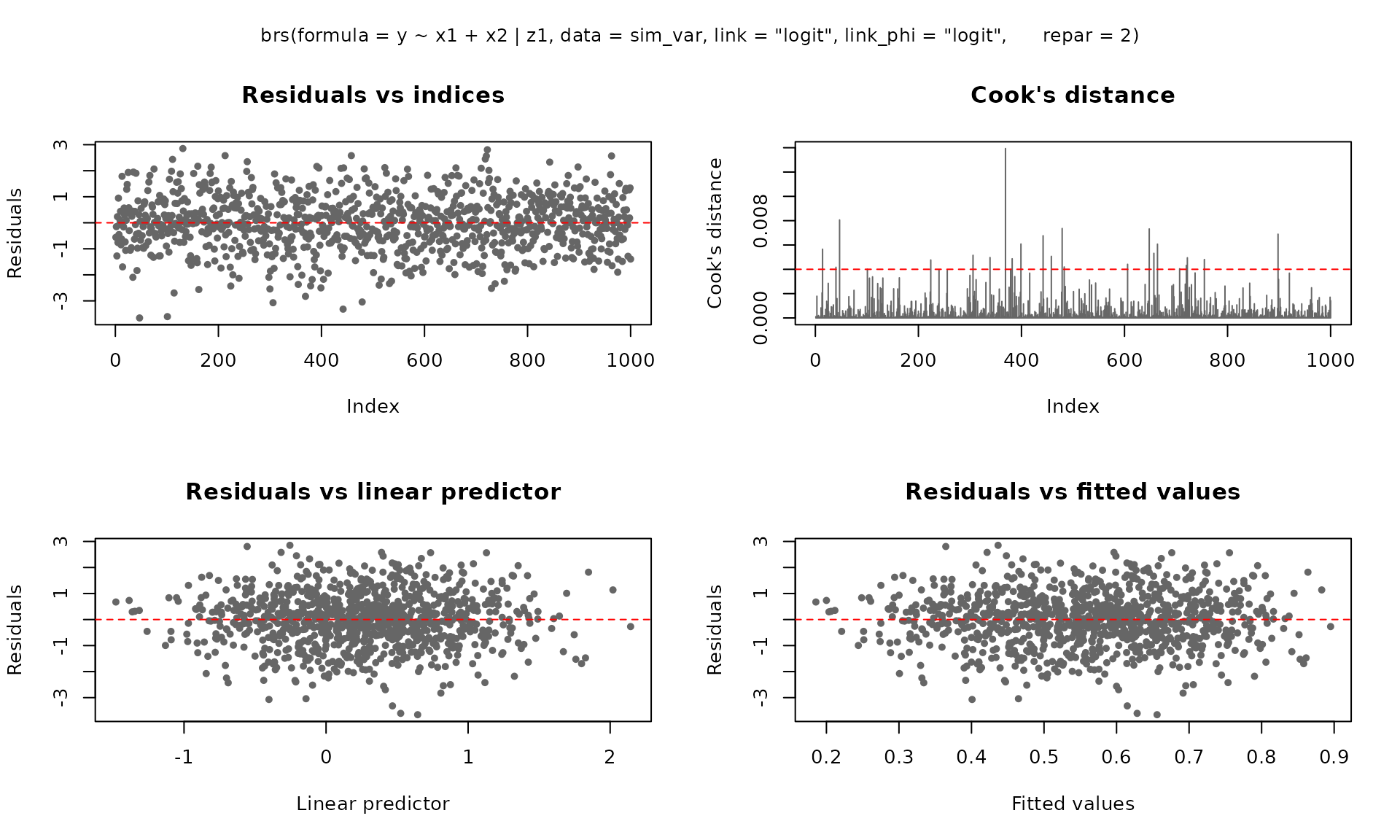
Example 2: Variable dispersion model
In many applications, the dispersion parameter
may depend on covariates. The package supports variable-dispersion
models using the Formula package notation:
y ~ x1 + x2 | z1 + z2, where the terms after |
define the linear predictor for
.
The same brs_sim() function is used for fixed and variable
dispersion; the second formula part activates the precision submodel in
simulation.
Simulating data
set.seed(2222)
n <- 250
dat_z <- data.frame(
  x1 = rnorm(n),
  x2 = rnorm(n),
  x3 = rbinom(n, size = 1, prob = 0.5),
  z1 = rnorm(n),
  z2 = rnorm(n)
)

sim_var <- brs_sim(
  formula = ~ x1 + x2 + x3 | z1 + z2,
  data = dat_z,
  beta = c(0.2, -0.6, 0.2, 0.2),
  zeta = c(0.2, -0.8, 0.6),
  link = "logit",
  link_phi = "logit",
  ncuts = 100,
  repar = 2
)

kbl10(head(sim_var, 10))| left | right | yt | y | delta | x1 | x2 | x3 | z1 | z2 |
|---|---|---|---|---|---|---|---|---|---|
| 0.000 | 0.005 | 0.00 | 0 | 1 | -0.3381 | 0.7980 | 1 | -0.1859 | 1.7165 |
| 0.000 | 0.005 | 0.00 | 0 | 1 | 0.9392 | -2.2067 | 0 | -1.1473 | 0.8539 |
| 0.985 | 0.995 | 0.99 | 99 | 3 | 1.7377 | 0.0134 | 0 | 0.3364 | 0.9417 |
| 0.535 | 0.545 | 0.54 | 54 | 3 | 0.6963 | 0.2765 | 1 | 2.1178 | 0.1317 |
| 0.515 | 0.525 | 0.52 | 52 | 3 | 0.4623 | -0.8707 | 1 | 0.5450 | -0.3795 |
| 0.005 | 0.015 | 0.01 | 1 | 3 | -0.3151 | -1.0969 | 1 | -0.4672 | -0.8259 |
| 0.005 | 0.015 | 0.01 | 1 | 3 | 0.1927 | 1.8391 | 0 | -1.2001 | -0.1784 |
| 0.035 | 0.045 | 0.04 | 4 | 3 | 1.1307 | -1.3548 | 0 | -0.6740 | -0.9092 |
| 0.315 | 0.325 | 0.32 | 32 | 3 | 1.9764 | 0.6912 | 1 | 0.9831 | 0.0286 |
| 0.825 | 0.835 | 0.83 | 83 | 3 | 1.2071 | 0.2571 | 0 | 0.6295 | -0.2415 |
Fitting the model
fit_var <- brs(
  y ~ x1 + x2 | z1,
  data     = sim_var,
  link     = "logit",
  link_phi = "logit",
  repar    = 2
)
summary(fit_var)
#>
#> Call:
#> brs(formula = y ~ x1 + x2 | z1, data = sim_var, link = "logit",
#>     link_phi = "logit", repar = 2)
#>
#> Quantile residuals:
#>     Min      1Q  Median      3Q     Max
#> -3.2736 -0.5585  0.0259  0.6191  2.5197
#>
#> Coefficients (mean model with logit link):
#>             Estimate Std. Error z value Pr(>|z|)
#> (Intercept)  0.31885    0.08541   3.733 0.000189 ***
#> x1          -0.48245    0.08961  -5.384 7.28e-08 ***
#> x2           0.23904    0.08270   2.890 0.003847 **
#> ---
#> Signif. codes:  0 '***' 0.001 '**' 0.01 '*' 0.05 '.' 0.1 ' ' 1
#>
#> Phi coefficients (precision model with logit link):
#>             Estimate Std. Error z value Pr(>|z|)
#> (Intercept)  0.33338    0.08621   3.867  0.00011 ***
#> z1          -0.81258    0.09204  -8.829  < 2e-16 ***
#> ---
#> Signif. codes:  0 '***' 0.001 '**' 0.01 '*' 0.05 '.' 0.1 ' ' 1
#> ---
#> Log-likelihood: -936.0499 on 5 Df | AIC: 1882.0998 | BIC: 1899.7071
#> Pseudo R-squared: 0.1164  (midpoint approx.; interpret with caution for heavily censored data)
#> Number of iterations: 43 (BFGS)
#> Censoring: 181 interval | 23 left | 46 right
Notice the (phi)_ prefix in the precision coefficient
names, following the betareg convention.
Accessing coefficients by submodel
# Full parameter vector
round(coef(fit_var), 4)
#>       (Intercept)                x1                x2 (phi)_(Intercept)
#>            0.3188           -0.4825            0.2390            0.3334
#>          (phi)_z1
#>           -0.8126

# Mean submodel only
round(coef(fit_var, model = "mean"), 4)
#> (Intercept)          x1          x2
#>      0.3188     -0.4825      0.2390

# Precision submodel only
round(coef(fit_var, model = "precision"), 4)
#> (phi)_(Intercept)          (phi)_z1
#>            0.3334           -0.8126

# Variance-covariance matrix for the mean submodel
kbl10(vcov(fit_var, model = "mean"))| (Intercept) | x1 | x2 | |
|---|---|---|---|
| (Intercept) | 0.0073 | -3e-04 | 0.0002 |
| x1 | -0.0003 | 8e-03 | 0.0001 |
| x2 | 0.0002 | 1e-04 | 0.0068 |
Comparing link functions (variable dispersion)
links <- c("logit", "probit", "cauchit", "cloglog")
fits_var <- lapply(setNames(links, links), function(lnk) {
  brs(y ~ x1 + x2 | z1, data = sim_var, link = lnk, repar = 2)
})

# Estimates
est_var <- do.call(rbind, lapply(names(fits_var), function(lnk) {
  e <- brs_est(fits_var[[lnk]])
  e$link <- lnk
  e
}))
kbl10(est_var)| variable | estimate | se | z_value | p_value | ci_lower | ci_upper | link |
|---|---|---|---|---|---|---|---|
| (Intercept) | 0.3188 | 0.0854 | 3.7333 | 0.0002 | 0.1515 | 0.4862 | logit |
| x1 | -0.4825 | 0.0896 | -5.3841 | 0.0000 | -0.6581 | -0.3068 | logit |
| x2 | 0.2390 | 0.0827 | 2.8904 | 0.0038 | 0.0770 | 0.4011 | logit |
| (phi)_(Intercept) | 0.3334 | 0.0862 | 3.8669 | 0.0001 | 0.1644 | 0.5024 | logit |
| (phi)_z1 | -0.8126 | 0.0920 | -8.8287 | 0.0000 | -0.9930 | -0.6322 | logit |
| (Intercept) | 0.1972 | 0.0524 | 3.7601 | 0.0002 | 0.0944 | 0.3000 | probit |
| x1 | -0.2980 | 0.0541 | -5.5038 | 0.0000 | -0.4041 | -0.1919 | probit |
| x2 | 0.1477 | 0.0505 | 2.9237 | 0.0035 | 0.0487 | 0.2467 | probit |
| (phi)_(Intercept) | 0.3326 | 0.0862 | 3.8571 | 0.0001 | 0.1636 | 0.5015 | probit |
| (phi)_z1 | -0.8131 | 0.0920 | -8.8379 | 0.0000 | -0.9934 | -0.6327 | probit |
| logLik | AIC | BIC | pseudo_r2 | |
|---|---|---|---|---|
| logit | -936.0499 | 1882.100 | 1899.707 | 0.1164 |
| probit | -935.9539 | 1881.908 | 1899.515 | 0.1211 |
| cauchit | -936.7522 | 1883.504 | 1901.112 | 0.0957 |
| cloglog | -935.6783 | 1881.357 | 1898.964 | 0.0667 |
Advanced analyst functions
The package includes analyst-facing helpers for uncertainty quantification, effect interpretation, score-scale communication, and predictive validation.
Parametric bootstrap confidence intervals
Each replicate draws a new response from the fitted model and refits
the original formula on a copy of the data. Each row keeps its
observation mechanism: exact values stay continuous, scores are
re-coarsened on the fit’s grid, and analyst thresholds from
brs_prep() are kept as fixed, non-informative thresholds
(the censoring type is re-drawn by the side of them where the new value
falls). Refits start from the fitted estimate. Failed replicates are
counted and printed. Use R of at least 199 in practice;
ci_type = "bca" costs one extra refit per observation.
set.seed(101)
boot_ci <- brs_bootstrap(
  fit_fixed,
  R = 30,
  level = 0.95,
  ci_type = "percentile",
  keep_draws = TRUE
)
kbl10(head(boot_ci, 10))| parameter | estimate | se_boot | ci_lower | ci_upper | mcse_lower | mcse_upper | wald_lower | wald_upper | level |
|---|---|---|---|---|---|---|---|---|---|
| (Intercept) | 0.3546 | 0.0982 | 0.1768 | 0.5276 | 0.0291 | 0.0298 | 0.1835 | 0.5257 | 0.95 |
| x1 | -0.6590 | 0.1044 | -0.8213 | -0.4645 | 0.0213 | 0.0344 | -0.8449 | -0.4732 | 0.95 |
| x2 | 0.3288 | 0.1088 | 0.1437 | 0.5298 | 0.0244 | 0.0287 | 0.1481 | 0.5095 | 0.95 |
| (phi) | 0.1514 | 0.0913 | 0.0432 | 0.3201 | 0.0101 | 0.0193 | -0.0093 | 0.3122 | 0.95 |
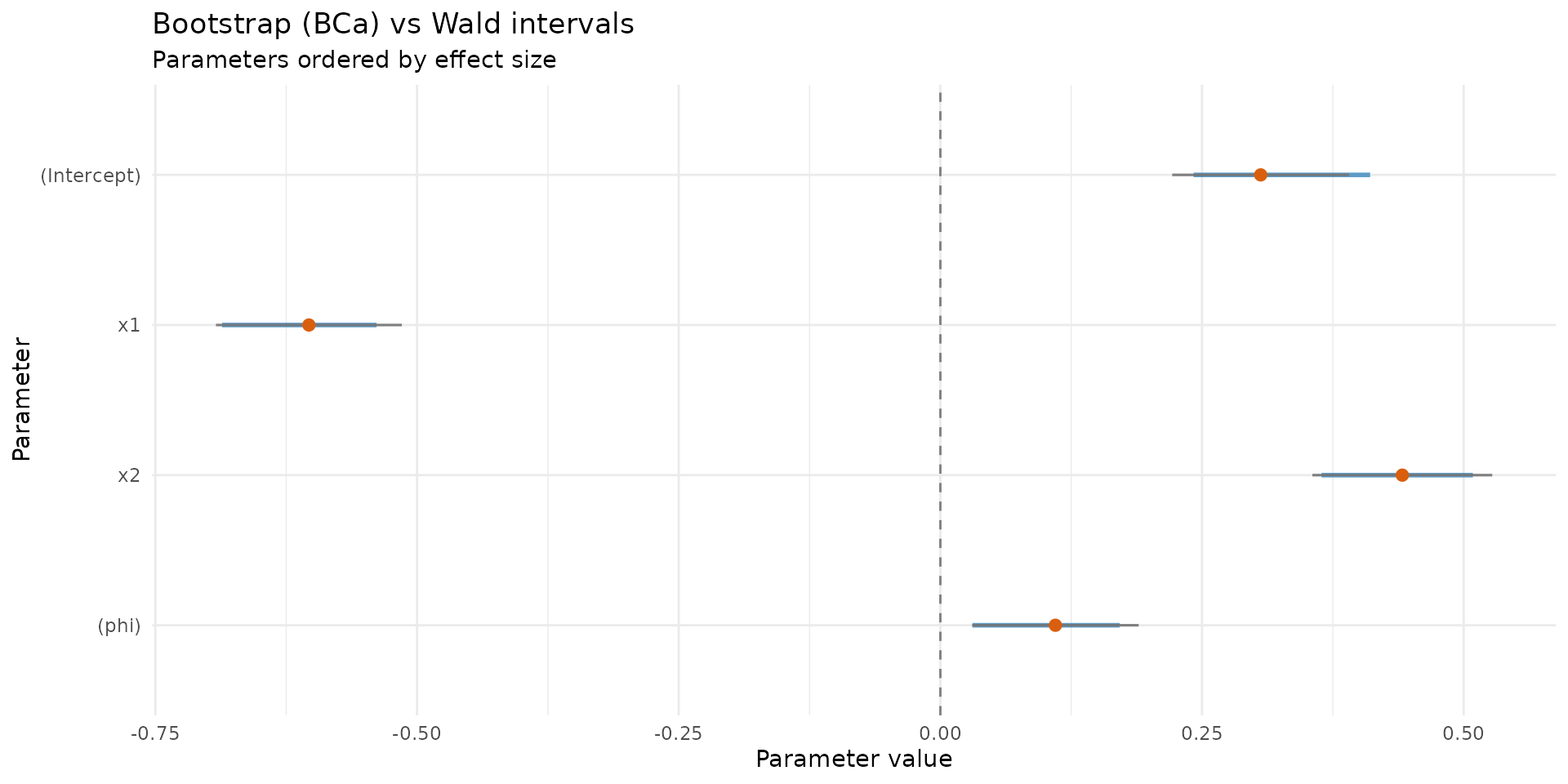
autoplot.brs_bootstrap(
  boot_ci,
  type = "ci_forest",
  title = "Bootstrap (percentile) vs Wald intervals"
)
Average marginal effects (AME)
set.seed(202)
ame <- brs_marginaleffects(
  fit_fixed,
  model = "mean",
  type = "response",
  interval = TRUE,
  n_sim = 60,
  keep_draws = TRUE
)
kbl10(ame)| variable | ame | std.error | ci.lower | ci.upper | model | type | n |
|---|---|---|---|---|---|---|---|
| x1 | -0.1425 | 0.0175 | -0.1764 | -0.1123 | mean | response | 250 |
| x2 | 0.0711 | 0.0184 | 0.0378 | 0.1055 | mean | response | 250 |
autoplot.brs_marginaleffects(ame, type = "forest")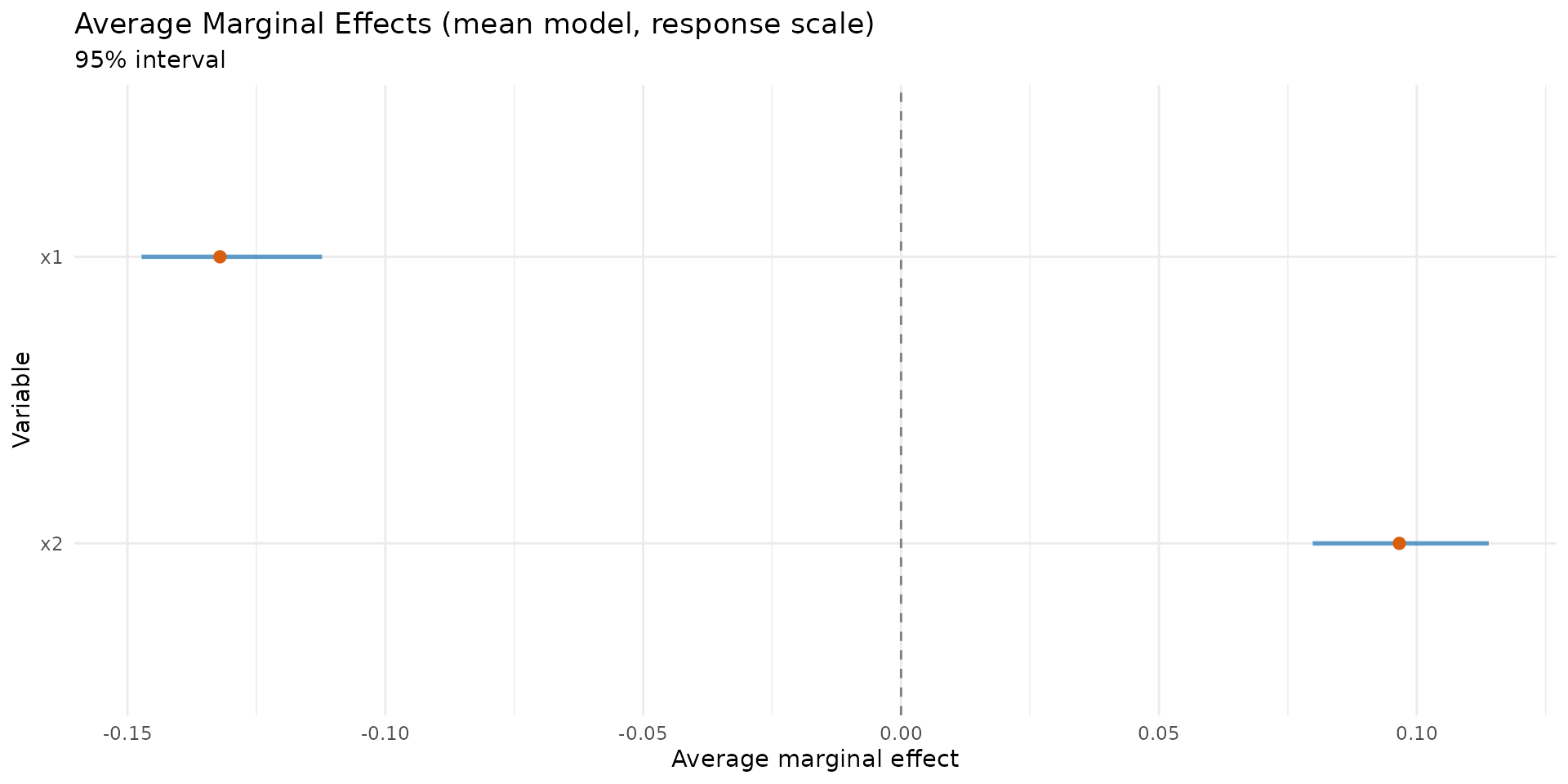
Score probabilities on the original scale
prob_scores <- brs_predict_scoreprob(fit_fixed, scores = 0:10)
kbl10(prob_scores[1:6, 1:6])| score_0 | score_1 | score_2 | score_3 | score_4 | score_5 |
|---|---|---|---|---|---|
| 0.3600 | 0.0758 | 0.0406 | 0.0289 | 0.0228 | 0.0190 |
| 0.0393 | 0.0280 | 0.0192 | 0.0157 | 0.0136 | 0.0122 |
| 0.0403 | 0.0285 | 0.0195 | 0.0159 | 0.0137 | 0.0123 |
| 0.0252 | 0.0205 | 0.0147 | 0.0122 | 0.0108 | 0.0098 |
| 0.0171 | 0.0155 | 0.0115 | 0.0097 | 0.0087 | 0.0080 |
| 0.0587 | 0.0363 | 0.0240 | 0.0191 | 0.0163 | 0.0145 |
kbl10(
  data.frame(row_sum = rowSums(prob_scores)[1:6]),
  digits = 4
)| row_sum |
|---|
| 0.6136 |
| 0.1774 |
| 0.1802 |
| 0.1340 |
| 0.1044 |
| 0.2261 |
Repeated k-fold cross-validation
set.seed(303) # For cross-validation reproducibility
cv_res <- brs_cv(
  y ~ x1 + x2,
  data = sim_fixed,
  k = 5,
  repeats = 2,
  repar = 2,
)
kbl10(cv_res)| repeat | fold | n_train | n_test | log_score | rmse_yt | mae_yt | converged | error |
|---|---|---|---|---|---|---|---|---|
| 1 | 1 | 200 | 50 | -4.0896 | 0.3338 | 0.2852 | TRUE | NA |
| 1 | 2 | 200 | 50 | -4.0065 | 0.3482 | 0.3080 | TRUE | NA |
| 1 | 3 | 200 | 50 | -3.7595 | 0.3069 | 0.2693 | TRUE | NA |
| 1 | 4 | 200 | 50 | -3.9121 | 0.3660 | 0.3281 | TRUE | NA |
| 1 | 5 | 200 | 50 | -4.0921 | 0.3834 | 0.3422 | TRUE | NA |
| 2 | 1 | 200 | 50 | -4.2336 | 0.3669 | 0.3191 | TRUE | NA |
| 2 | 2 | 200 | 50 | -3.8826 | 0.3231 | 0.2829 | TRUE | NA |
| 2 | 3 | 200 | 50 | -3.8884 | 0.3151 | 0.2787 | TRUE | NA |
| 2 | 4 | 200 | 50 | -4.0835 | 0.3745 | 0.3272 | TRUE | NA |
| 2 | 5 | 200 | 50 | -3.8069 | 0.3697 | 0.3366 | TRUE | NA |
kbl10(
  data.frame(
    metric = c("log_score", "rmse_yt", "mae_yt"),
    mean = c(
      mean(cv_res$log_score, na.rm = TRUE),
      mean(cv_res$rmse_yt, na.rm = TRUE),
      mean(cv_res$mae_yt, na.rm = TRUE)
    )
  ),
  digits = 4
)| metric | mean |
|---|---|
| log_score | -3.9755 |
| rmse_yt | 0.3488 |
| mae_yt | 0.3077 |
S3 methods reference
The following standard S3 methods are available for objects of class
"brs":
| Method | Description |
|---|---|
print() |
Compact display of call and coefficients |
summary() |
Detailed output with Wald tests and goodness-of-fit |
coef(model=) |
Extract coefficients (full, mean, or precision) |
vcov(model=) |
Variance-covariance matrix (full, mean, or precision) |
confint(model=) |
Wald confidence intervals |
logLik() |
Log-likelihood value |
AIC(), BIC()
|
Information criteria |
nobs() |
Number of observations |
formula() |
Model formula |
model.matrix(model=) |
Design matrix (mean or precision) |
fitted() |
Fitted mean values |
residuals(type=) |
Residuals: response, pearson, deviance, rqr, weighted, sweighted |
predict(type=) |
Predictions: response, link, precision, variance, quantile, score, expected_score |
plot(gg=) |
Diagnostic plots (base R or ggplot2) |
Reparameterizations
The package supports three reparameterizations of the beta
distribution, controlled by the repar argument. Each models
different parameters, so the admissible links differ; the first link of
each cell is the default.
repar |
parameters | shapes | link |
link_phi |
|---|---|---|---|---|
| 0 | shapes | log, sqrt | log, sqrt | |
| 1 | mean , precision | logit, probit, cauchit, cloglog | log, sqrt | |
| 2 | mean , dispersion | logit, probit, cauchit, cloglog | logit, probit, cauchit, cloglog |
In every scheme
and
.
Under repar = 1 this is
(Ferrari and Cribari-Neto, 2004); under repar = 2 it is
,
so the dispersion is
,
the variance relative to its maximum
(not a coefficient of variation). Under repar = 0 the first
parameter is the shape
and the mean is
.
References
Lopes, J. E. (2023). Modelos de regressão beta para dados de escala. Master’s dissertation, Universidade Federal do Paraná, Curitiba. https://hdl.handle.net/1884/86624.
Dunn, P. K., and Smyth, G. K. (1996). Randomized quantile residuals. Journal of Computational and Graphical Statistics, 5(3), 236–244.
Ferrari, S. L. P., and Cribari-Neto, F. (2004). Beta regression for modelling rates and proportions. Journal of Applied Statistics, 31(7), 799–815. DOI: 10.1080/0266476042000214501. Validated online via: https://doi.org/10.1080/0266476042000214501.
Smithson, M., and Verkuilen, J. (2006). A better lemon squeezer? Maximum-likelihood regression with beta-distributed dependent variables. Psychological Methods, 11(1), 54–71. DOI: 10.1037/1082-989X.11.1.54. Validated online via: https://doi.org/10.1037/1082-989X.11.1.54.
Hawker, G. A., Mian, S., Kendzerska, T., and French, M. (2011). Measures of adult pain: Visual Analog Scale for Pain (VAS Pain), Numeric Rating Scale for Pain (NRS Pain), McGill Pain Questionnaire (MPQ), Short-Form McGill Pain Questionnaire (SF-MPQ), Chronic Pain Grade Scale (CPGS), Short Form-36 Bodily Pain Scale (SF-36 BPS), and Measure of Intermittent and Constant Osteoarthritis Pain (ICOAP). Arthritis Care and Research, 63(S11), S240–S252. DOI: 10.1002/acr.20543. Validated online via: https://doi.org/10.1002/acr.20543.
Hjermstad, M. J., Fayers, P. M., Haugen, D. F., et al. (2011). Studies comparing numerical rating scales, verbal rating scales, and visual analogue scales for assessment of pain intensity in adults: a systematic literature review. Journal of Pain and Symptom Management, 41(6), 1073–1093. DOI: 10.1016/j.jpainsymman.2010.08.016. Validated online via: https://doi.org/10.1016/j.jpainsymman.2010.08.016.