Produces ggplot2 diagnostics tailored to interval-censored scale models.
Usage
# S3 method for class 'brs'
autoplot(
  object,
  type = c("calibration", "score_dist", "cdf", "residuals_by_delta", "all"),
  bins = 10L,
  scores = NULL,
  newdata = NULL,
  n_grid = 200L,
  max_curves = 6L,
  residual_type = "rqr",
  title = NULL,
  xlab = NULL,
  ylab = NULL,
  ncol = 2L,
  theme = ggplot2::theme_minimal(),
  ...
)
Arguments
- object
A fitted
"brs"object.- type
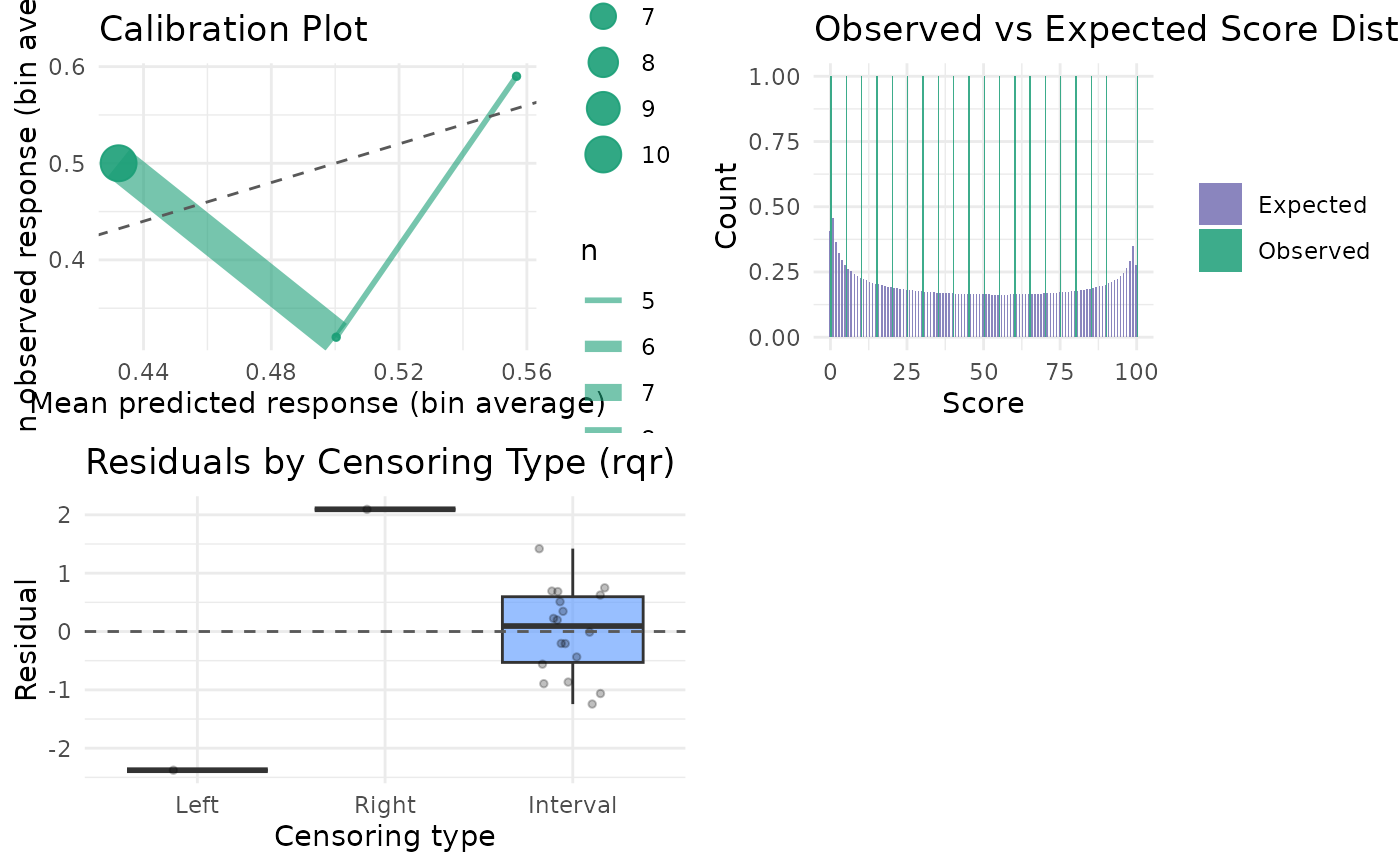
Plot type:
"calibration","score_dist","cdf","residuals_by_delta", or"all"(produces all panels in a single grid).- bins
Number of bins for
"calibration".- scores
Optional integer vector of scores for
"score_dist". Defaults to all scores from0toncuts.- newdata
Optional data frame of covariate scenarios for
"cdf".- n_grid
Number of points on \((0,1)\) used to draw CDF curves.
- max_curves
Maximum number of CDF curves shown when
newdatais not provided.- residual_type
Residual type for
"residuals_by_delta"; passed toresiduals.brs.- title
Optional character: override the plot title via
ggplot2::labs(title = ...). Ignored whentype = "all".- xlab
Optional character: override the x-axis label. Ignored when
type = "all".- ylab
Optional character: override the y-axis label. Ignored when
type = "all".- ncol
Number of columns for the grid when
type = "all". Defaults to 2.- theme
A ggplot2 theme object (e.g.,
ggplot2::theme_bw()) or a theme function. Applied to every panel. Defaults toggplot2::theme_minimal().- ...
Additional arguments forwarded to
ggplot2::theme()and applied on top oftheme. Use named theme element arguments, e.g.legend.position = "none".
Details
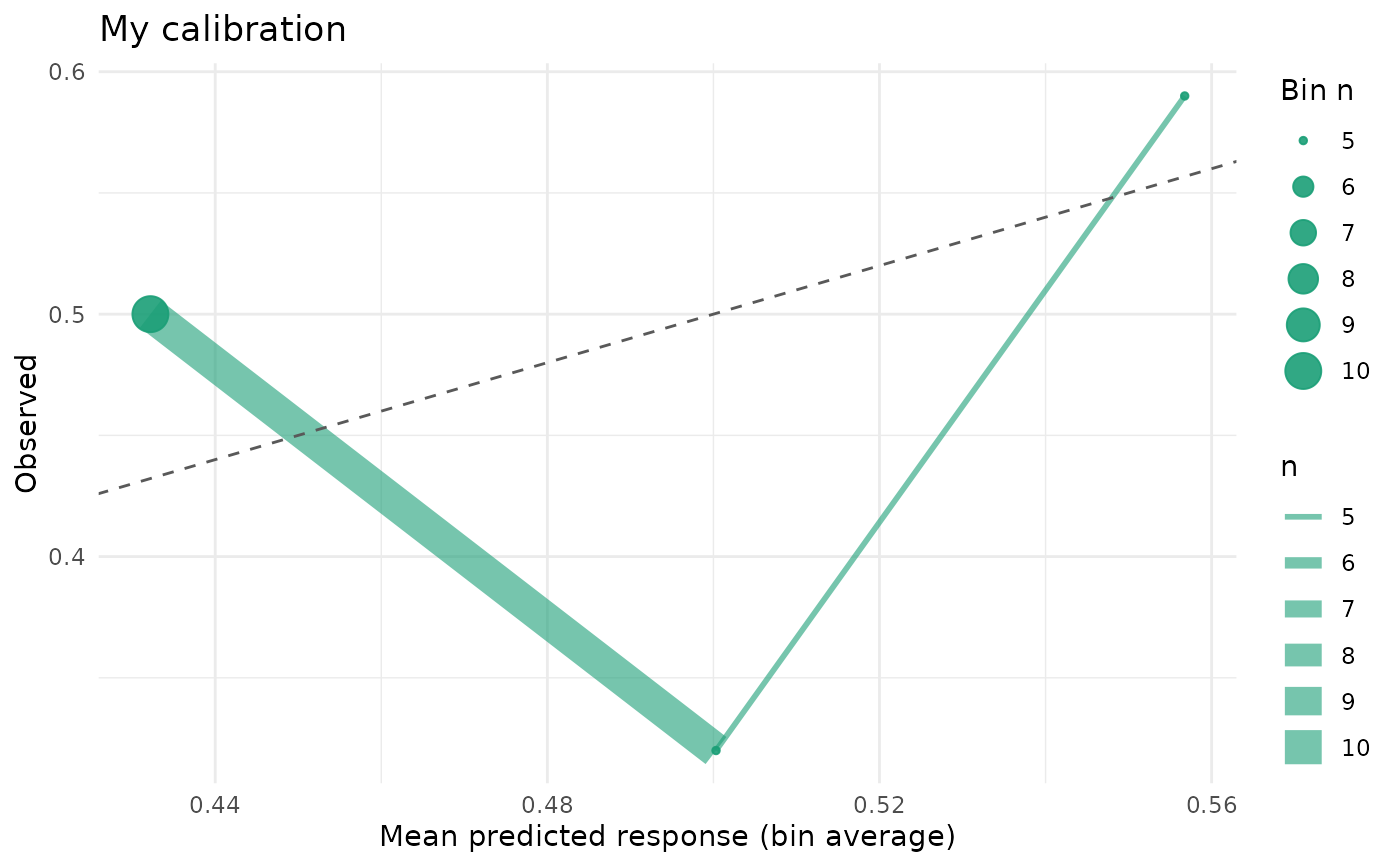
type = "calibration" bins predictions and compares mean observed vs
mean predicted response in each bin.
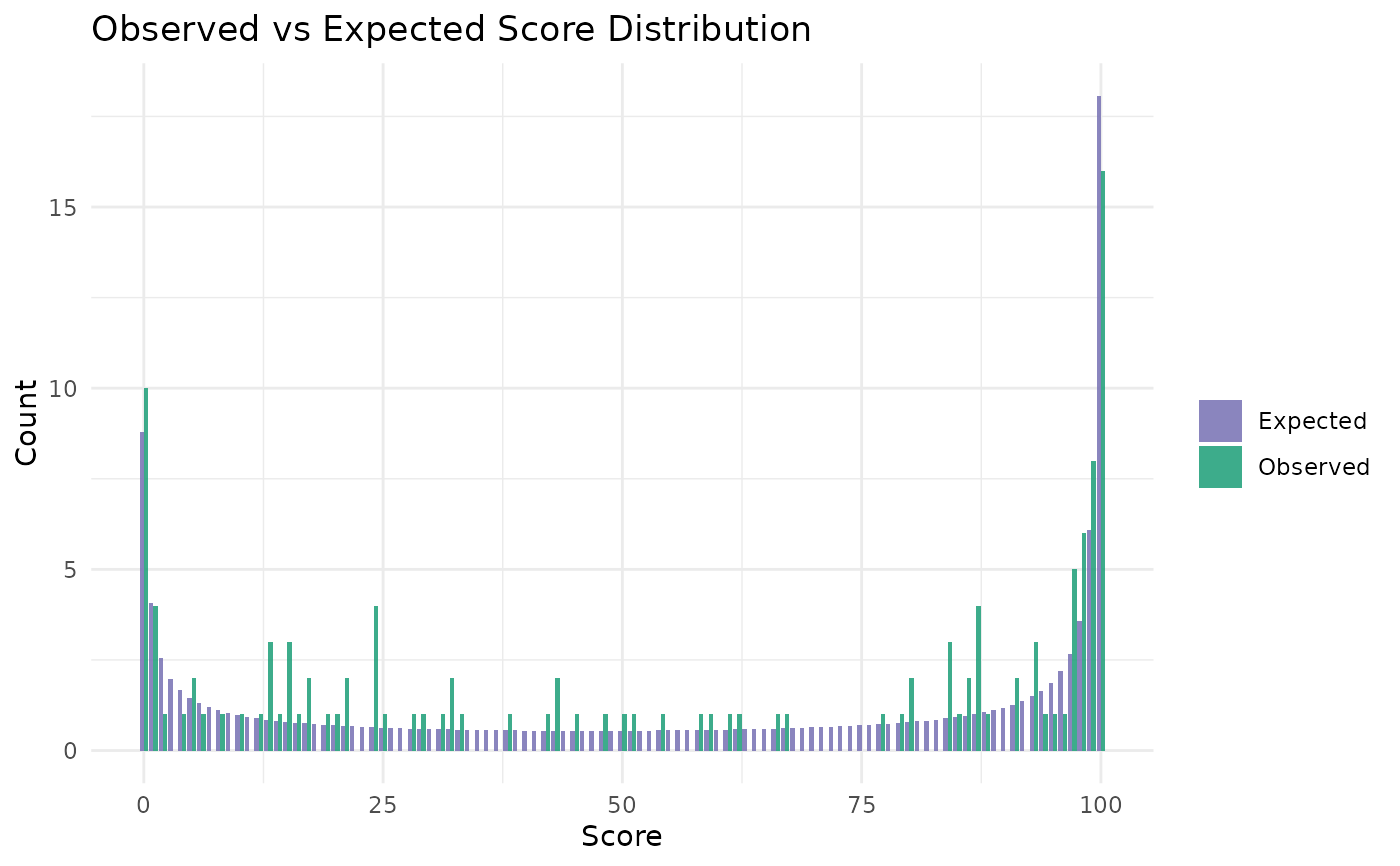
type = "score_dist" compares observed score frequencies against
expected frequencies implied by the fitted beta interval model.
References
Lopes, J. E. (2023). Modelos de regressao beta para dados de escala. Master's dissertation, Universidade Federal do Parana, Curitiba. URI: https://hdl.handle.net/1884/86624.
Hawker, G. A., Mian, S., Kendzerska, T., and French, M. (2011). Measures of adult pain: Visual Analog Scale for Pain (VAS Pain), Numeric Rating Scale for Pain (NRS Pain), McGill Pain Questionnaire (MPQ), Short-Form McGill Pain Questionnaire (SF-MPQ), Chronic Pain Grade Scale (CPGS), Short Form-36 Bodily Pain Scale (SF-36 BPS), and Measure of Intermittent and Constant Osteoarthritis Pain (ICOAP). Arthritis Care and Research, 63(S11), S240-S252. doi:10.1002/acr.20543
Hjermstad, M. J., Fayers, P. M., Haugen, D. F., et al. (2011). Studies comparing Numerical Rating Scales, Verbal Rating Scales, and Visual Analogue Scales for assessment of pain intensity in adults: a systematic literature review. Journal of Pain and Symptom Management, 41(6), 1073-1093. doi:10.1016/j.jpainsymman.2010.08.016
Examples
# \donttest{
dat <- data.frame(
y = c(
0, 5, 20, 50, 75, 90, 100, 30, 60, 45,
10, 40, 55, 70, 85, 25, 35, 65, 80, 15
),
x1 = rep(c(1, 2), 10),
x2 = rep(c(0, 0, 1, 1), 5)
)
prep <- brs_prep(dat, ncuts = 100)
#> brs_prep: n = 20 | exact = 0, left = 1, right = 1, interval = 18
fit <- brs(y ~ x1 + x2, data = prep)
ggplot2::autoplot(fit, type = "calibration")
 ggplot2::autoplot(fit,
type = "calibration",
title = "My calibration", ylab = "Observed"
)
ggplot2::autoplot(fit,
type = "calibration",
title = "My calibration", ylab = "Observed"
)
 ggplot2::autoplot(fit, type = "all")
 # }
# }