Random Number Generation for the Beta Distribution (gamma, delta+1 Parameterization)
Source:R/beta.R
rbeta_.RdGenerates random deviates from the standard Beta distribution, using a
parameterization common in generalized distribution families. The distribution
is parameterized by gamma (\(\gamma\)) and delta (\(\delta\)),
corresponding to the standard Beta distribution with shape parameters
shape1 = gamma and shape2 = delta + 1. This is a special case
of the Generalized Kumaraswamy (GKw) distribution where \(\alpha = 1\),
\(\beta = 1\), and \(\lambda = 1\).
Arguments
- n
Number of observations. If
length(n) > 1, the length is taken to be the number required. Must be a non-negative integer.- gamma
First shape parameter (
shape1), \(\gamma > 0\). Can be a scalar or a vector. Default: 1.0.- delta
Second shape parameter is
delta + 1(shape2), requires \(\delta \ge 0\) so thatshape2 >= 1. Can be a scalar or a vector. Default: 0.0 (leading toshape2 = 1, i.e., Uniform).
Value
A numeric vector of length n containing random deviates from the
Beta(\(\gamma, \delta+1\)) distribution, with values in (0, 1). The length
of the result is determined by n and the recycling rule applied to
the parameters (gamma, delta). An out-of-bound or missing parameter is an
error, not a return value: the wrapper stops with a message naming the
parameter. An infinite parameter is not currently intercepted there and
reaches the C++ layer, which treats it as invalid.
Details
This function generates samples from a Beta distribution with parameters
shape1 = gamma and shape2 = delta + 1. It is equivalent to
calling stats::rbeta(n, shape1 = gamma, shape2 = delta + 1).
This distribution arises as a special case of the five-parameter
Generalized Kumaraswamy (GKw) distribution (rgkw) obtained
by setting \(\alpha = 1\), \(\beta = 1\), and \(\lambda = 1\).
It is therefore also equivalent to the McDonald (Mc)/Beta Power distribution
(rmc) with \(\lambda = 1\).
The function likely calls R's underlying rbeta function but ensures
consistent parameter recycling and handling within the C++ environment,
matching the style of other functions in the related families.
References
Johnson, N. L., Kotz, S., & Balakrishnan, N. (1995). Continuous Univariate Distributions, Volume 2 (2nd ed.). Wiley.
Cordeiro, G. M., & de Castro, M. (2011). A new family of generalized distributions. Journal of Statistical Computation and Simulation, 81(7), 883-898. doi:10.1080/00949650903530745
Devroye, L. (1986). Non-Uniform Random Variate Generation. Springer-Verlag.
Examples
set.seed(123)
x <- rbeta_(1000, gamma = 2, delta = 3)
summary(x)
#> Min. 1st Qu. Median Mean 3rd Qu. Max.
#> 0.01114 0.20168 0.31755 0.33709 0.45444 0.90972
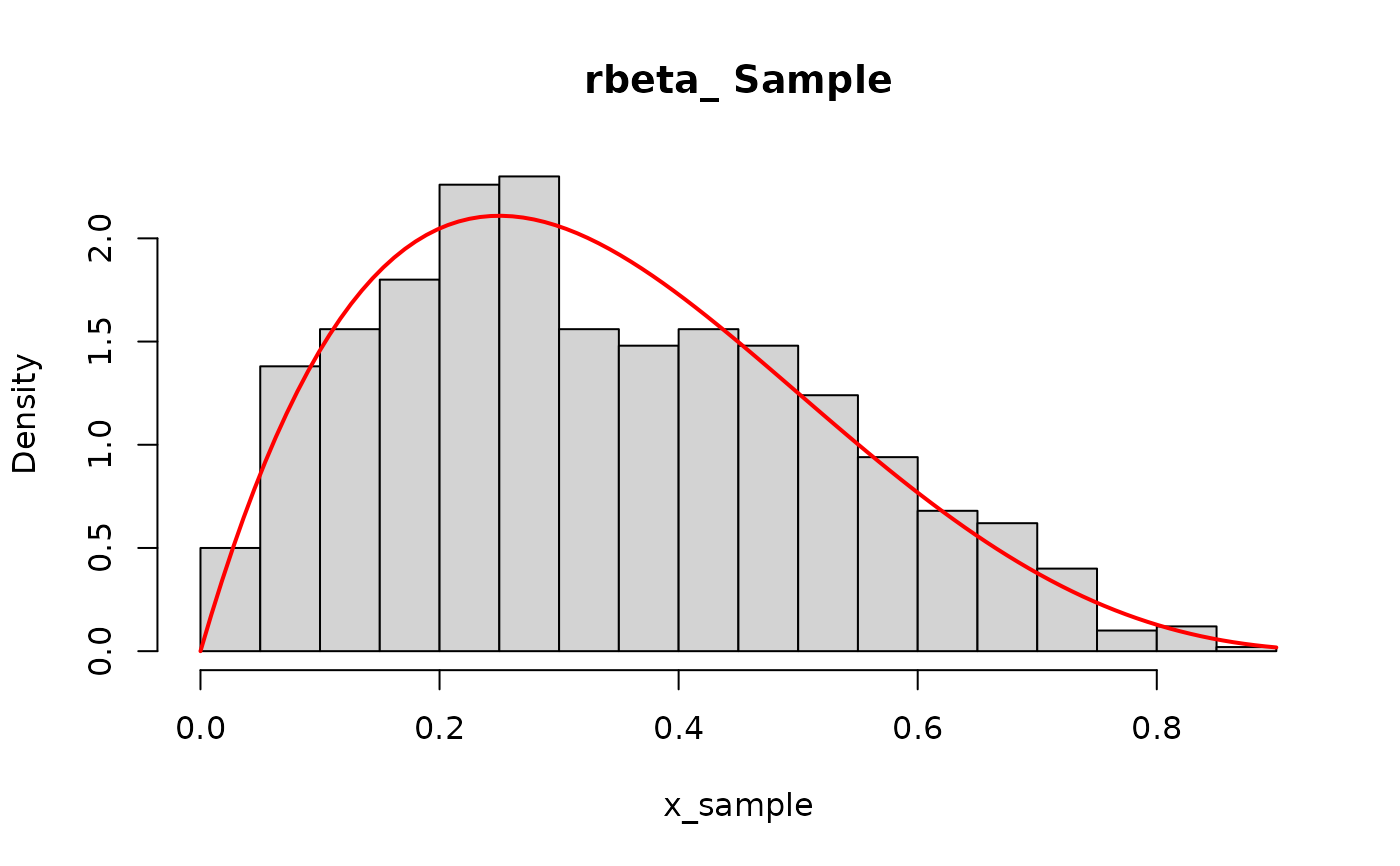
## The sample follows the distribution
hist(x, breaks = 30, freq = FALSE, main = "")
curve(dbeta_(x, gamma = 2, delta = 3), add = TRUE)
 ks.test(x, pbeta_, gamma = 2, delta = 3)
#>
#> Asymptotic one-sample Kolmogorov-Smirnov test
#>
#> data: x
#> D = 0.026144, p-value = 0.5013
#> alternative hypothesis: two-sided
#>
ks.test(x, pbeta_, gamma = 2, delta = 3)
#>
#> Asymptotic one-sample Kolmogorov-Smirnov test
#>
#> data: x
#> D = 0.026144, p-value = 0.5013
#> alternative hypothesis: two-sided
#>