Optimal Binning for Numerical Variables using Local Density Binning
Source:R/obn_ldb.R
ob_numerical_ldb.RdImplements supervised discretization via Local Density Binning (LDB), a method that leverages kernel density estimation to identify natural transition regions in the feature space while optimizing the Weight of Evidence (WoE) monotonicity and Information Value (IV) for binary classification tasks.
Usage
ob_numerical_ldb(
  feature,
  target,
  min_bins = 3,
  max_bins = 5,
  bin_cutoff = 0.05,
  max_n_prebins = 20,
  enforce_monotonic = TRUE,
  convergence_threshold = 1e-06,
  max_iterations = 1000
)
Arguments
- feature
Numeric vector of feature values to be binned. Missing values (NA) Missing values (
NA/NaN) are excluded from the fit silently, so the bin counts sum to the number of non-missing rows. Infinite values are legitimate extremes: they never become cutpoints and are counted in the first (-Inf) or last (+Inf) bin.- target
Integer vector of binary target values (must contain only 0 and 1). Must have the same length as
feature. Missing values are not permitted (an error is raised).- min_bins
Minimum number of bins to generate (default: 3). Must be at least 2.
- max_bins
Maximum number of bins to generate (default: 5). Must be greater than or equal to
min_bins.- bin_cutoff
Minimum fraction of total observations in each bin (default: 0.05). Bins with frequency below this threshold are merged with adjacent bins, but only while more than
min_binsbins remain:min_binstakes precedence, so bins below the cutoff are kept oncemin_binsis reached (see Details). Must be in the range [0, 1].- max_n_prebins
Maximum number of pre-bins before optimization (default: 20). Controls granularity of initial density-based discretization.
- enforce_monotonic
Logical flag to enforce monotonicity in WoE values across bins (default: TRUE). When enabled, bins violating monotonicity are iteratively merged until global monotonicity is achieved.
- convergence_threshold
Convergence threshold for iterative optimization (default: 1e-6). Currently used for future extensions.
- max_iterations
Maximum number of iterations for merging operations (default: 1000). Prevents infinite loops in edge cases. The
max_binslimit is enforced even beyond this cap, which is then reported throughconverged = FALSE.
Value
A list containing:
- id
Integer vector of bin identifiers (1-based indexing).
- bin
Character vector of bin intervals in the format
"(lower;upper]".- woe
Numeric vector of Weight of Evidence values for each bin.
- iv
Numeric vector of Information Value contributions for each bin.
- count
Integer vector of total observations in each bin.
- count_pos
Integer vector of positive class (target = 1) counts per bin.
- count_neg
Integer vector of negative class (target = 0) counts per bin.
- event_rate
Numeric vector of event rates (proportion of positives) per bin.
- cutpoints
Numeric vector of cutpoints defining bin boundaries (excluding -Inf and +Inf).
- converged
Logical flag indicating whether the algorithm converged within
max_iterations.- iterations
Integer count of iterations performed during optimization.
- total_iv
Numeric scalar representing the total Information Value (sum of all bin IVs).
- monotonicity
Character string indicating monotonicity status:
"increasing","decreasing", or"none".
Details
Algorithm Overview
The Local Density Binning (LDB) algorithm operates in four sequential phases:
Phase 1: Density-Based Pre-binning
The algorithm employs kernel density estimation (KDE) with a Gaussian kernel to identify the local density structure of the feature:
$$\hat{f}(x) = \frac{1}{nh\sqrt{2\pi}} \sum_{i=1}^{n} \exp\left[-\frac{(x - x_i)^2}{2h^2}\right]$$
where \(h\) is the bandwidth computed via Silverman's rule of thumb:
$$h = 0.9 \times \min(\hat{\sigma}, \text{IQR}/1.34) \times n^{-1/5}$$
with \(\hat{\sigma}\) the population standard deviation (divisor \(n\)) and
\(h\) floored at \(\text{range}/1000\), so it can differ from
bw.nrd0.
Bin boundaries are placed at local minima of \(\hat{f}(x)\), which correspond to natural transition regions where density is lowest (analogous to valleys in the density landscape). This strategy ensures bins capture homogeneous subpopulations.
Phase 2: Weight of Evidence Computation
For each bin \(i\), the WoE quantifies the log-ratio of positive to negative class distributions, adjusted with Laplace smoothing (\(\alpha = 0.5\)) to prevent division by zero:
$$\text{WoE}_i = \ln\left(\frac{\text{DistGood}_i}{\text{DistBad}_i}\right)$$
where:
$$\text{DistGood}_i = \frac{n_{i}^{+} + \alpha}{n^{+} + K\alpha}, \quad \text{DistBad}_i = \frac{n_{i}^{-} + \alpha}{n^{-} + K\alpha}$$
and \(K\) is the total number of bins. The Information Value for bin \(i\) is:
$$\text{IV}_i = \left(\frac{n_i^{+}}{n^{+}} - \frac{n_i^{-}}{n^{-}}\right) \times \text{WoE}_i$$
(the unsmoothed class distributions; smoothing enters through the WoE only).
Total IV aggregates discriminatory power: \(\text{IV}_{\text{total}} = \sum_{i=1}^{K} \text{IV}_i\).
Phase 3: Monotonicity Enforcement
When enforce_monotonic = TRUE, the algorithm ensures WoE values are
monotonic with respect to bin order. The direction (increasing/decreasing) is
determined via Pearson correlation between bin indices and WoE values. Bins
violating monotonicity are iteratively merged using the merge strategy described
in Phase 4, continuing until global monotonicity is achieved or min_bins
is reached.
This approach is rooted in isotonic regression principles (Robertson et al., 1988), ensuring the scorecard maintains a consistent logical relationship between feature values and credit risk.
Phase 4: Adaptive Bin Merging
Two merging criteria are applied sequentially:
Frequency-based merging: Bins with total count below
bin_cutoff\(\times n\) are merged with the adjacent bin having the most similar event rate (minimizing heterogeneity). If event rates are equivalent, the merge that preserves higher IV is preferred. Merging stops atmin_bins, which takes precedence overbin_cutoff. On a smooth, unimodal sample the only density minima are bumps between isolated tail observations; they have the lowest density and are chosen first, so the cuts can fall in the sparse tails and leave bins of a handful of observations. With no minimum at all the engine uses quantile cuts. Lowermin_binsor choose another algorithm in that case.Cardinality reduction: If the number of bins exceeds
max_bins, the pair of adjacent bins minimizing IV loss when merged is identified via: $$\Delta \text{IV}_{i,i+1} = \text{IV}_i + \text{IV}_{i+1} - \text{IV}_{\text{merged}}$$ This greedy optimization continues until \(K \le\)max_bins.
Theoretical Foundations
Kernel Density Estimation: The bandwidth selection follows Silverman (1986, Chapter 3), balancing bias-variance tradeoff for univariate density estimation.
Weight of Evidence: Siddiqi (2006) presents WoE/IV as measures of predictive strength in credit scoring, with the usual IV bands: \(< 0.02\) (unpredictive), 0.02-0.1 (weak), 0.1-0.3 (medium), 0.3-0.5 (strong); an IV above 0.5 is commonly treated as a warning sign.
Supervised Discretization: García et al. (2013) categorize LDB within "static" supervised methods that do not require iterative feedback from the model, unlike dynamic methods (e.g., ChiMerge).
Computational Complexity
KDE computation: \(O(n + G^2)\) by linear binning on a fixed grid of \(G = 512\) points (the naive estimator is \(O(n^2)\)).
Binary search for bin assignment: \(O(n \log K)\) where \(K\) is the number of bins.
Merge iterations: \(O(K^2 \times \text{max\_iterations})\) in worst case.
For large datasets the initial sort, \(O(n \log n)\), dominates runtime.
References
Silverman, B. W. (1986). Density Estimation for Statistics and Data Analysis. Chapman and Hall/CRC.
Siddiqi, N. (2006). Credit Risk Scorecards: Developing and Implementing Intelligent Credit Scoring. Wiley.
Dougherty, J., Kohavi, R., & Sahami, M. (1995). "Supervised and Unsupervised Discretization of Continuous Features". Proceedings of the 12th International Conference on Machine Learning, pp. 194-202.
Robertson, T., Wright, F. T., & Dykstra, R. L. (1988). Order Restricted Statistical Inference. Wiley.
García, S., Luengo, J., Sáez, J. A., López, V., & Herrera, F. (2013). "A Survey of Discretization Techniques: Taxonomy and Empirical Analysis in Supervised Learning". IEEE Transactions on Knowledge and Data Engineering, 25(4), 734-750.
See also
ob_numerical_mdlp for Minimum Description Length Principle binning,
ob_numerical_mob for monotonic binning with similar constraints.
Examples
# \donttest{
# Simulate credit scoring data
set.seed(42)
n <- 10000
feature <- c(
rnorm(3000, mean = 600, sd = 50), # Low-risk segment
rnorm(4000, mean = 700, sd = 40), # Medium-risk segment
rnorm(3000, mean = 750, sd = 30) # High-risk segment
)
target <- c(
rbinom(3000, 1, 0.15), # 15% default rate
rbinom(4000, 1, 0.08), # 8% default rate
rbinom(3000, 1, 0.03) # 3% default rate
)
# Apply LDB with monotonicity enforcement
result <- ob_numerical_ldb(
feature = feature,
target = target,
min_bins = 3,
max_bins = 5,
bin_cutoff = 0.05,
max_n_prebins = 20,
enforce_monotonic = TRUE
)
# Inspect binning quality
print(result$total_iv) # Should be > 0.1 for predictive features
#> [1] 0.1912603
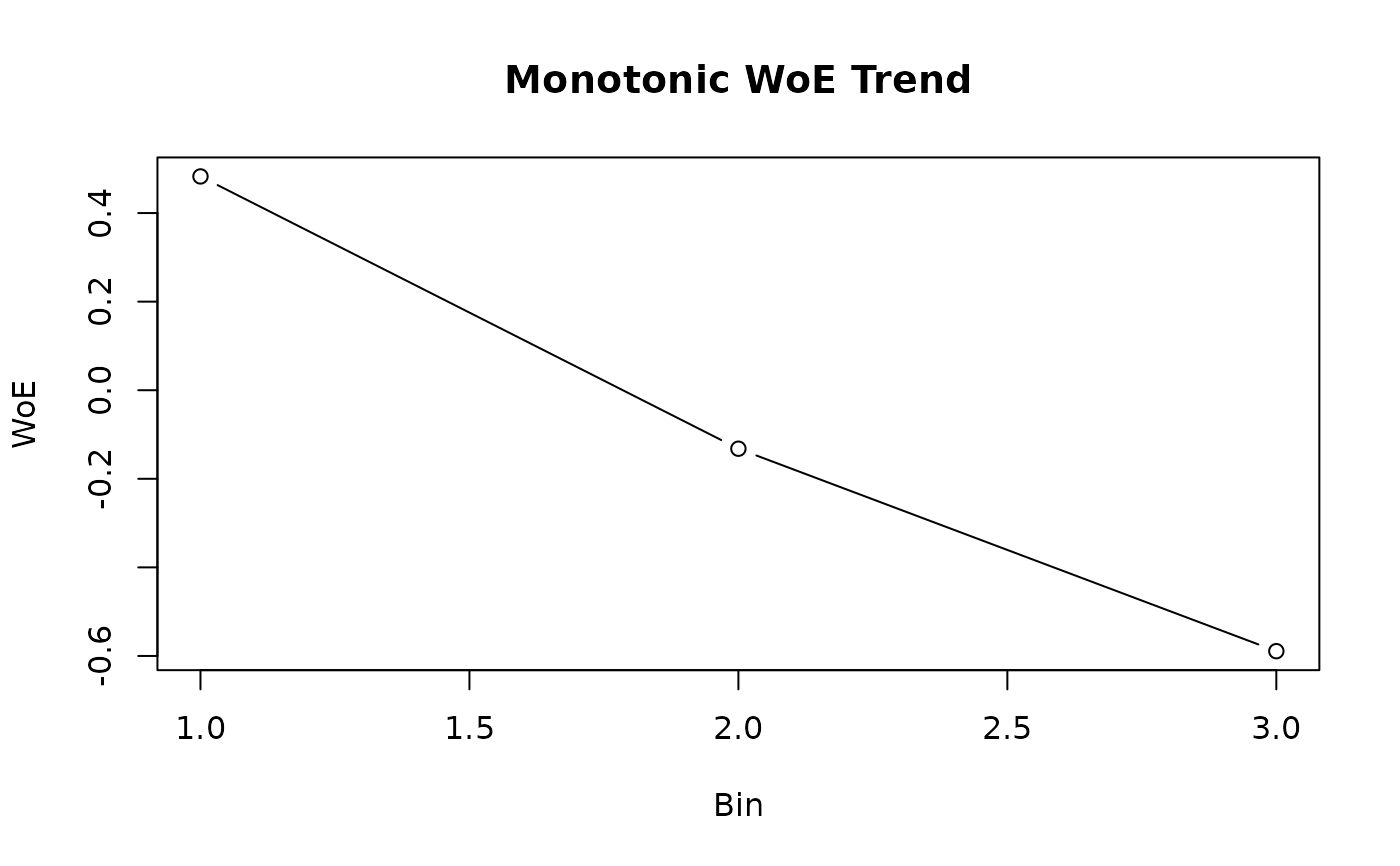
print(result$monotonicity) # Should indicate direction
#> [1] "decreasing"
# Visualize WoE pattern
plot(result$woe,
type = "b", xlab = "Bin", ylab = "WoE",
main = "Monotonic WoE Trend"
)
 # Generate scorecard transformation
bin_mapping <- data.frame(
bin = result$bin,
woe = result$woe,
iv = result$iv
)
print(bin_mapping)
#> bin woe iv
#> 1 (-Inf;660.733735] 0.4823607 0.094709827
#> 2 (660.733735;726.780204] -0.1320751 0.005514779
#> 3 (726.780204;+Inf] -0.5888786 0.091035700
# }
# Generate scorecard transformation
bin_mapping <- data.frame(
bin = result$bin,
woe = result$woe,
iv = result$iv
)
print(bin_mapping)
#> bin woe iv
#> 1 (-Inf;660.733735] 0.4823607 0.094709827
#> 2 (660.733735;726.780204] -0.1320751 0.005514779
#> 3 (726.780204;+Inf] -0.5888786 0.091035700
# }